If Video Is Your Storefront, Don't Settle for the Camera in the Box

Integrated eye-contact webcams get the geometry right and the economics wrong. For professionals, the camera is the one component you should never let someone else choose, or freeze in time.
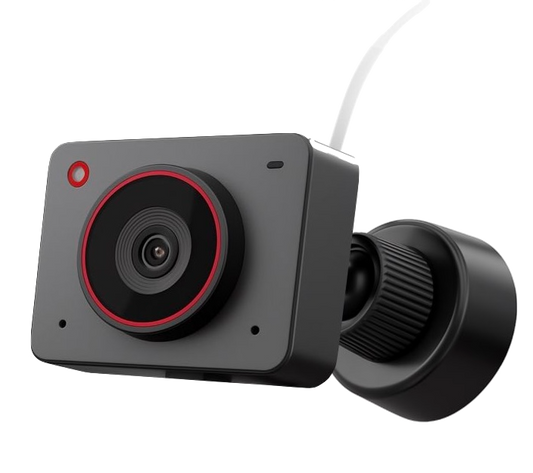
A new category of webcam has emerged over the past few years: the integrated eye-contact camera. Products like the iContact Camera Pro suspend a small camera from an arm that drops down from your monitor's top bezel, positioning the lens near your sightline. The premise is exactly right. We've argued since 2020 that eye contact is a camera-position problem, not a camera-quality problem, and it's genuinely good news that more companies are building for it.
But there's a design decision buried inside every integrated unit that deserves more scrutiny than it gets: the camera, the microphones, the arm, and the mount are one sealed object. You don't choose the sensor. You can't replace it. And where the arm reaches is where your camera lives.
For a casual user, someone making the occasional family call or the monthly check-in, that trade-off is invisible. The built-in sensor is fine, the fixed position is fine, and the convenience is real. If that's your video life, an integrated unit will serve you well, and we'd tell you so.
If you're a professional, the calculus is different. And the difference compounds every year.
You are buying two inches of reach
Start with what actually separates the models in an arm-based lineup. iContact sells four: the ProMini for laptops with a 3.25 inch arm, the Pro for desktops at 4.2 inches, the Pro XL for large displays at 5.2 inches, and the ProHello at 4.2 inches. Line those up and the entire product range spans about two inches of vertical reach, with roughly $10 to $40 separating one model from the next.
That is the decision the buyer is being asked to make at checkout: how far down the front of your screen do you need the lens to hang? Not which sensor, not which mount, not how the thing fits the way you work. Two inches, priced by the inch.
Now play it forward. You buy the laptop model this year because you work on a 14 inch screen. Next year the company issues a 27 inch monitor, or you finally buy the ultrawide you've wanted. Your 3.25 inch arm now drops the camera into the top strip of a much taller display, well above the meeting window where the faces actually are. The fix is not an adjustment. The fix is buying the next model up, which means buying the camera again, because the camera and the arm are the same object.
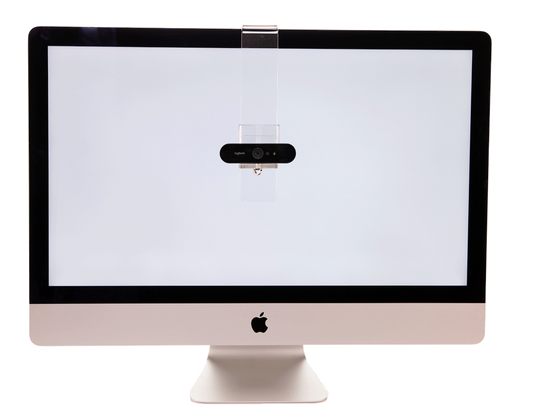
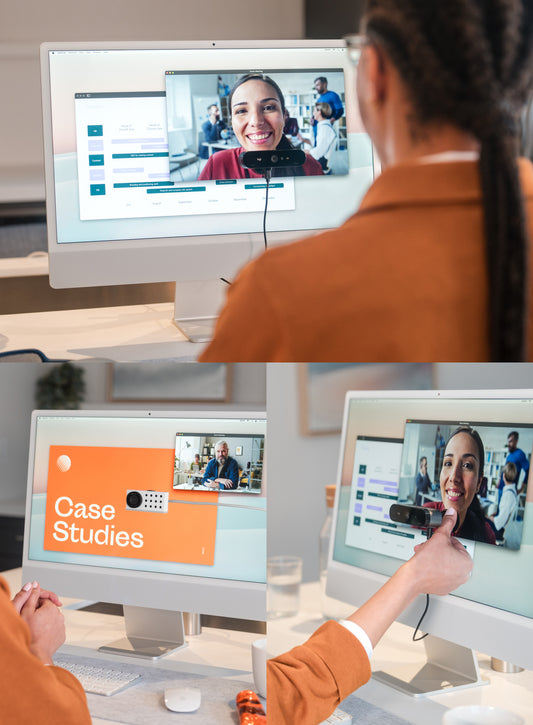
A magnetic mount has no equivalent of this problem, because there is no arm and therefore no reach to run out of. The Mag2 attaches anywhere on the glass, on a laptop or a 34 inch ultrawide, and moves with you when the screen changes. One mount covers every screen size you will ever own, and the position is a choice you make daily rather than a spec you purchased.
The camera is the part that ages
Consider what's happened to webcams recently: 4K sensors at 60 frames per second, AI-driven gimbals that physically track you as you move, dramatically better low-light performance, computational framing that used to require a production team. The Insta360 Link literally repositions itself to keep you centered. The Logitech MX Brio resolves detail that would have required a mirrorless camera five years ago.
An integrated eye-contact unit ships with the sensor its designers chose the year it was engineered, typically a solid, mid-range 4K/30 module, and that's the sensor you'll have for the life of the product. When the next generation of webcams arrives, and it always arrives, your options are two: live with yesterday's image, or discard the entire unit (arm, mount, mics, and all) and buy the next one.
A modular mount inverts that. The PlexiCam Mag2 is a display-safe magnetic mount with an integrated USB-C adapter; the camera that rides on it is whichever one you choose. Brio 4K today, MX Brio next year, whatever ships after that. The mount is infrastructure. The camera is a component. You upgrade components.


Why this is a professional issue, not an enthusiast one
If you're a keynote speaker, a founder raising capital, an executive running a distributed team, or a seller whose pipeline lives on Zoom, your video image is doing work that used to be done by a firm handshake, a corner office, and a good suit. It's your storefront. People form judgments about your competence and preparation from it. Research on video communication has been telling us this for years, and every buyer, board, and hiring committee confirms it.
Professionals don't accept "the one that came in the box" for anything else that represents them. Not their laptop, not their monitor, not their microphone if audio matters to their work. The camera, the single component that determines how you actually look, is a strange place to make an exception. Best-in-class image quality is a choice you should get to make, and remake, as the technology improves.
There's a second professional consideration: position. An arm-mounted integrated camera hangs at a fixed drop from the top bezel, sliding only along the top edge. That's adequate if your meeting window sits where the arm happens to reach. But professionals increasingly work on large and ultrawide displays where the meeting occupies one region of the screen and documents, notes, or a CRM occupy the rest. Eye contact means the camera sits over the eyes you're looking at, which means you need to put it there, wherever there is today.

The math of buying once
The prices are close enough that this isn't a budget decision: the iContact Camera Pro lists at $189; the Mag2 mount is $139, or $199 as the Mag2 Plus bundle with an OBSBOT Meet SE HD webcam included. The divergence shows up over time. Two webcam generations from now, the integrated buyer has purchased two or three complete units, possibly including one bought purely because their screen got bigger. The Mag2 owner has bought cameras, the same cameras a pro would have wanted anyway, and the mount from year one is still doing its job, on whatever screen they're using, at whatever position the work requires.
Eye contact is a permanent requirement. Cameras are temporary technology. Screens keep getting bigger. Professionals should buy accordingly.
See the full side-by-side comparison of the Mag2 and the iContact Camera Pro, or go straight to the Mag2 mount ($139) and the Mag2 Plus bundle with HD webcam ($199).
iContact Camera model names, arm lengths, specifications, and pricing from icontactcamera.com as of August 2026. iContact Camera is a trademark of its owner; PlexiCam is not affiliated with iContact Camera. Logitech, Insta360, OBSBOT, and other camera brands referenced are trademarks of their respective owners.